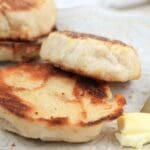
Overnight Sourdough English Muffins
These overnight sourdough English muffins couldn’t be easier—or more delicious. Make the dough before bed, then cook them up in the morning for a super quick scratch-made breakfast. There's no intense kneading or second rise required!
Servings: 12 muffins
Calories: 105kcal
Equipment
- Large Bowl
Ingredients
Overnight Dough
- 300 g all-purpose or bread flour see notes
- 240 g water
- 120 g sourdough starter active and bubbly
- 21 g honey
For Mixing the Next Day
- 5 g baking soda
- 10 g water
- 6 g salt
- cornmeal for dusting
- avocado oil spray or butter for greasing the skillet
Instructions
Make the Dough
- Make the Dough. In a large mixing bowl, combine the flour, water, starter, and honey. Mix until combined (I like using a Danish dough whisk for this).300 g all-purpose or bread flour, 240 g water, 120 g sourdough starter, 21 g honey
- Knead and Ferment. With the dough still in the bowl, knead by hand for 2–3 minutes to start developing gluten. Add flour or water one tablespoon at a time if needed. The dough should form a ball and feel slightly sticky. Cover with a damp towel and let ferment overnight.
The Next Morning
- Mix the Leavener. In a small bowl, combine the baking soda and water in a small dish. Set aside.5 g baking soda, 10 g water
- Add the Salt. Sprinkle the salt evenly over the top of the dough and mix it in with your hands just until combined. The dough will deflate.6 g salt
- Add the Leavener. Pour the baking soda mixture over the dough, and mix it in with your hands. The dough will feel wet at this point, but the mixture will help the baking soda incorporate more evenly throughout the dough.
- Preheat and Prep. Set the dough aside and allow it to rest and absorb the baking soda mixture. Meanwhile, preheat the oven to 350° F and preheat a cast iron skillet over medium heat. Then, line a baking dish with parchment paper and sprinkle it with cornmeal.cornmeal for dusting
- Divide and Shape: When the oven is ready, turn the dough onto the counter and divide it into 10–12 pieces. Pinch each into a dumpling shape, place the seam-side down, and gently spin it into a ball.Transfer each to the cornmeal-dusted sheet, sliding them a little to coat the bottoms. Press gently to slightly flatten into an English muffin shape, then sprinkle the tops with more cornmeal.
- Cook on the Skillet. Grease the skillet with avocado oil spray or butter. Place 3–4 muffins in the skillet, about 2" apart. Cook 2 minutes per side, until golden brown. Transfer back to the baking sheet and repeat with the rest of the dough. I usually re-grease the skillet between batches to ensure even browning.avocado oil spray or butter for greasing the skillet
- Bake and Cool. Once all are browned, bake for 10–15 minutes, or until an instant-read thermometer inserted in the center reads 190°F. Larger muffins may take longer. Transfer to a wire rack and let cool. Cooling improves the chewy texture.
- Toast. To crisp them like a classic English muffin, slice the muffin open, slather it with butter, and toast it buttered-side down on a hot cast iron skillet.
Video
Notes
- Both all-purpose and bread flour work. All-purpose makes a softer, biscuit-like muffin, while bread flour gives a chewier texture. Bread flour dough mixes with the baking soda a bit less easily, but the results are still great.
- The baking soda may cause the muffins to brown more throughout the crumb. This is normal and simply a tradeoff for the quicker method. It doesn’t affect the flavor.
- Adjust the heat on the skillet as needed to prevent burning the English muffins. I usually oscillate mine between medium-low and low.
- A slightly sticky dough creates a better texture for English muffins.
- Because the muffins are browned on the outside before baking, it can be tricky to judge doneness by color alone. Use a digital thermometer. The muffins are ready when the internal temperature reaches 190°–200°F.
Nutrition
Serving: 1muffin | Calories: 105kcal | Carbohydrates: 3g | Protein: 0.3g | Fat: 0.02g | Sodium: 309mg | Potassium: 1mg | Fiber: 0.1g | Sugar: 1g | Vitamin C: 0.01mg | Calcium: 1mg | Iron: 0.01mg
