How To Feed Sourdough Starter from the Fridge
Servings: 1 jar
Calories: 573kcal
Equipment
- Mason Jar
- Loose Lid or Cloth Cover with Rubber Band
Ingredients
- 130 g sourdough starter
- 130 g flour (any unbleached wheat flour)
- 130 g water (filtered)
Instructions
- Before you get started: For my weekly feedings, as you'll see in the step-by-step instructions below, I use 130 g of starter, flour, and water for each feeding.This is the amount that works for my weekly baking needs. But you can feed your starter more or less depending on how much starter you need or want. Just make sure you feed it equal parts (in grams) starter, flour, and water. So, for example, where I feed mine 130:130:130, you may feed yours 50:50:50.
- Remove the starter from the fridge.
- Transfer 130 g sourdough starter into a clean jar. Set aside the remaining starter that is in the "old jar."
- Add 130 g flour to the starter that is in the new, clean jar. I usually use half all-purpose and half whole wheat for each feeding.
- Pour 130 g water of water into the jar.
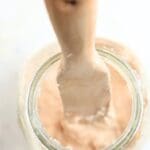
- Using a spurtle or long spoon, stir until thoroughly combined and no dry flour remains.
- Scrape the sides with a small spatula, and wipe the rim with a clean towel.
- Cover with a loose-fitting lid or a cloth cover secured with a rubber band.
- If you are baking: wait until your freshly fed starter is bubbly and active before using it. Use what you need to bake, then stash the rest in the fridge.As long as you still have enough starter in your jar, you don't need to feed it again (unless you want to) until your next weekly feeding.If you are not baking: just stick your starter back in the fridge.
- Grab the jar of discard (the remaining starter in the "old jar").If the remaining starter (discard) is completely inactive (deflated and back to its original volume), you can transfer it to a container with an air-tight lid and store it in the fridge.If it is still bubbly, cover it with a loose-fitting lid or cloth cover secured with a rubber band.Use the discard at your convenience to make brownies, crepes, or other discard recipes.
- Repeat the feeding process weekly. Use the sourdough discard for other recipes, such as crepes, biscuits, or other treats.
Notes
- Need more help with your starter? My Sourdough Starter for Beginners course walks you through making a healthy starter and baking your first loaf with confidence!
- The 1:1 feeding ratio refers to grams, not volume. Since water weighs more than flour, feeding your starter with 1 cup of each will leave you with a soupy mess.
- For a freshly fed or bubbly, active starter, use a loose lid to allow gases to escape. A tight-fitting lid should only be used for completely inactive discard.
- What's left in the original jar is called discard, and it's money in the bank. It can be used for discard recipes and even to thicken soups. (Ps. Here are 12 easy discard recipes to try asap!)
- I’ve heard that chlorinated tap water won’t work for starter, but I haven’t had experience with that. So, stick to filtered water to stay on the safe side.
Nutrition
Serving: 1 | Calories: 573kcal | Carbohydrates: 131g | Protein: 7g | Fat: 1g | Sodium: 15mg | Potassium: 26mg | Fiber: 3g | Sugar: 5g | Vitamin C: 7mg | Calcium: 199mg | Iron: 7mg
