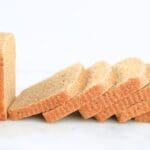
Fresh-Milled Sourdough Pullman Loaf (Pain De Mie)
This fresh-milled sourdough Pullman loaf is pillowy soft and absolutely delicious. With a thin crust, tender crumb, and mild flavor, it's as close as you can get to store-bought white bread texture—but with 100% whole-grain nutrition!
Servings: 20 slices
Calories: 168kcal
Equipment
- Grain Mill
Ingredients
- 370 g hard white wheat berries 2 cups wheat berries
- 160 g kamut wheat berries just over 3/4 cups wheat berries
- 20 g vital wheat gluten
- 10 g sunflower lecithin
- 375 g water
- 115 g sourdough starter
- 58 g unsalted butter softened and cubed
- 30 g honey
- 11 g salt
Instructions
- Mill the Wheat Berries. Just before prepping the dough, mill the hard white wheat and kamut on the finest setting. (If you are measuring in volume, you should have about 4 1/3 cups total flour after milling.)370 g hard white wheat berries, 160 g kamut wheat berries
- Add the Ingredients (except salt). In the bowl of a stand mixer, add the freshly milled flour, vital wheat gluten, sunflower lecithin, water, sourdough starter, butter, and honey (do not add the salt yet).20 g vital wheat gluten, 10 g sunflower lecithin, 375 g water, 115 g sourdough starter, 58 g unsalted butter, 30 g honey
- Mix and Rest. Using a paddle attachment, mix the ingredients together on low. Mix until just combined. Cover with a towel and allow the dough to rest (aka autolyze) for 30 minutes to 1 hour. The dough may seem too wet at this point. But the autolyzing will allow the flour to hydrate fully, so don't add extra flour.
- Add the Salt and Begin to Knead. Add the salt. Then, switch to the dough hook and knead on low until the dough forms a cohesive ball.If it is still sticky, add 1 tablespoon at a time of fresh-milled flour (hard white or kamut) until slightly tacky but not clinging to your hands. I usually need 2–3 tablespoons.Keep the mixer at or below KitchenAid speed 3 for best results.11 g salt
- Continue Kneading. Once the dough is the right consistency, knead it until it is smooth, elastic, and passes the windowpane test. This usually takes me about 10 minutes.
- Bulk Ferment. Transfer the dough to an oiled bowl. Cover with a damp towel and allow it to bulk ferment until it has doubled in size and is domed on top. This usually takes 3–5 hours at 75°F. The warmer the room, the faster it will ferment. The cooler, the slower it will ferment. Watch the dough, not the clock.
- Prep the Pan and Dough. Butter or grease a 13" Pullman loaf pan. Then, turn the dough out onto a clean work surface.
- Shape the Dough. Gently stretch the dough into a 13" rectangle-ish shape.
- Roll the Dough. Starting with the long edge of the dough closest to you, roll the dough into a tight log. To do this, tuck and pull back on the dough as you roll to create tension. Then, pinch the seams together.
- Proof. Transfer the rolled dough into the prepared Pullman pan. Press the dough gently to ensure it fills the pan to the edges. Cover with a damp towel and let it proof until it is about 1" from the top of the pan. You can use a proofing box to speed this up.
- Preheat and Cover. Once the dough has proofed, preheat the oven to 375° F. Grease the lid, then place the it on the pan.
- Bake. Bake with the lid on for 50-55 minutes or until the internal temperature reaches 200° F.
- Cool and Enjoy! Remove from the oven, take off the lid. Let it cool in the pan for a few minutes. Then, transfer to a wire rack. Allow to cool to room temperature before slicing and serving.
Notes
- I always keep a small bag of fresh-milled hard wheat in the freezer. That way, if I need to add a little to my dough, it's ready.
- I recommend weighing ingredients in grams for the most accurate and consistent results. Measuring by volume can vary since flour settles differently each time, and every mill grinds differently.
- Fresh-milled flour absorbs water slowly, so it is critical to let it rest (aka autolyze). I often skip this step for regular flour, but I never skip it for fresh-milled.
- Grains vary based on the type and growing conditions, so you may need more or less water. Adjust as you go, adding extra flour or water as needed.
- Working with fresh-milled flour is a bit different from store-bought, but the same qualities of “good” dough still apply. It may feel more textured from the bran and germ, and it might be slightly less elastic, but it should still be smooth, stretchy, and able to pass the windowpane test.
- With fresh-milled flour, the bran and germ can cause the dough to tear sooner during the windowpane test, but you should still see light pass through it.
Nutrition
Serving: 1slice | Calories: 168kcal | Carbohydrates: 28.7g | Protein: 6g | Fat: 4.3g | Saturated Fat: 2.1g | Polyunsaturated Fat: 0.8g | Monounsaturated Fat: 1g | Trans Fat: 0.1g | Cholesterol: 7.8mg | Sodium: 268mg | Potassium: 140mg | Fiber: 4.1g | Sugar: 1.7g | Vitamin A: 91IU | Vitamin C: 0.01mg | Calcium: 15mg | Iron: 1.4mg
