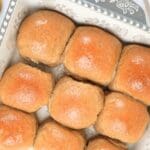
Fresh-Milled Dinner Rolls
These fresh-milled dinner rolls are soft, fluffy, and 100% whole grain. Made with active dry yeast, hard white wheat, and kamut, they have a mild flavor that the whole family will love.
Servings: 15 rolls
Calories: 99kcal
Equipment
- Grain Mill
- 9"x13" Baking Dish
Ingredients
Dough
- 300 g hard white wheat berries about 1 1/2 cups whole wheat berries
- 100 g kamut wheat berries about 1/2 cup whole wheat berries
- 1 cup whole milk
- 56 g butter softened
- 1 tablespoon vital wheat gluten
- 1 tablespoon sunflower lecithin
- 2 tablespoons granulated sugar
- 1 large egg
- 1 teaspoon salt
- 2 1/4 teaspoons active dry yeast 1 packet
Topping
- 2 tablespoons butter melted
Instructions
- Mill the Wheat Berries. Just before prepping the dough, mill the hard white wheat and kamut on the finest setting. (If you are measuring in volume, you should have about 4 cups of flour after milling.)300 g hard white wheat berries, 100 g kamut wheat berries
- Add the Ingredients (except salt and yeast). In the bowl of a stand mixer, combine the freshly milled flour, milk, butter, vital wheat gluten, sunflower lecithin, sugar, and egg.1 cup whole milk, 56 g butter, 1 tablespoon vital wheat gluten, 1 tablespoon sunflower lecithin, 2 tablespoons granulated sugar, 1 large egg
- Mix and Rest. Using the paddle attachment, mix on low just until everything comes together. Cover with a damp towel and let the dough rest for 30 minutes to 1 hour. It may look too wet at first, but the rest allows the flour to hydrate fully, so don’t add extra flour yet.
- Knead with Salt and Yeast. Add the salt and active dry yeast, then switch to the dough hook and knead on low until the dough comes together. If it’s still sticky, add fresh-milled flour 1 tablespoon at a time until the dough is soft and slightly tacky. Keep the mixer at speed 3 (no higher than 4).Knead until the dough is smooth, elastic, and passes the windowpane test (this takes me about 10 minutes)1 teaspoon salt, 2 1/4 teaspoons active dry yeast
- First Rise. Transfer the dough to an oiled bowl. Cover with a damp towel and allow it to rise until doubled in size, about 1-2 hours.
- Prep the Pan. Butter or grease a 9"x13" baking dish.
- Turn Out the Dough. Divide the dough into 15 equal portions (they don't have to be perfect).
- Shape the Dough. Shape each portion by first pulling and tucking the edges underneath to create a ball.Then, turn the dough clockwise while gently dragging it on the counter to create tension and tidy up the shape.
- Second Rise. Arrange the dough balls in the prepared baking dish, leaving about 1/4 inch space between them so they have room to rise. Cover with a damp towel and allow to proof until the dough is puffy and the sides of the dough balls are touching each other.
- Bake. When you are ready to bake, preheat the oven to 350° F. Bake for 20-25 minutes or until the internal temperature reaches 190°-200°F. (See notes about browning the tops.)
- Brush with Butter. As soon as the rolls come out of the oven, brush them with the melted butter. This will make them glossy and delicious, but it also helps trap the steam as they cool, making them softer.2 tablespoons butter
- Cool and Enjoy! If serving right away, let the rolls cool in the pan for a few minutes. If serving later, let them cool in the pan for a few minutes, then transfer to a wire rack and cool to room temperature.
Video
Notes
- In my oven, the tops usually don't brown, so just before they reach an internal temp of 190° F, I bump the oven up to 375° F, and let them finish baking. This does the trick for me.
- Dough made with fresh-milled flour has a more delicate gluten network because the bran and germ can pop the bubbles. I do not recommend punching down the dough after the first rise, as it can affect the bread's quality.
- You can omit the sunflower lecithin and vital wheat gluten. The rolls won't be quite as soft, but they will still be delicious.
- I like to keep a little extra fresh-milled flour in the freezer so I can easily adjust the dough while kneading without having to mill more flour.
Nutrition
Serving: 1serving | Calories: 99kcal | Carbohydrates: 3g | Protein: 2g | Fat: 5g | Saturated Fat: 3g | Polyunsaturated Fat: 0.2g | Monounsaturated Fat: 1g | Trans Fat: 0.2g | Cholesterol: 14mg | Sodium: 198mg | Potassium: 44mg | Fiber: 4g | Sugar: 2g | Vitamin A: 166IU | Vitamin C: 0.01mg | Calcium: 23mg | Iron: 0.1mg
