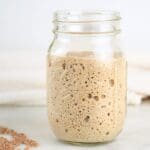
Einkorn Sourdough Starter
Learn how to make an einkorn sourdough starter with these simple steps. This foolproof guide is beginner-friendly and walks you through each step so you can bake with your einkorn starter in 10-14 days.
Servings: 1 jar
Calories: 182kcal
Equipment
- Pint Jar
- Loose-fitting lid
- Spurtle optional
Ingredients
- 50 g einkorn flour
- 50 g water
Instructions
Day 1
- Add the 50 grams of einkorn flour (approximately 1/2 cup) to a mason jar, then pour in 50 grams of water (approximately 1/4 cup). Stir well until thoroughly combined and no dry flour remains.50 g einkorn flour, 50 g water
- Cover the jar with a cloth secured by a rubber band, or use a loose-fitting lid. Let it sit at room temperature for 24 hours.
Days 2-5
- Transfer 50 grams of the sourdough starter into a clean jar. Throw the remaining starter away (the starter you throw away is called “discard”).
- Add 50 grams of einkorn flour and 50 grams of water to the 50 grams of reserved starter. Mix thoroughly.
- Cover and allow to sit at room temperature for 24 hours.
Days 6-End
- At this point, your starter may or may not be doubling with each feeding. Either way, begin feeding it every 12 hours. Follow the same steps and measurements as before for each feeding.Once your starter doubles regularly and smells good (like sourdough), it's time to start baking, usually around Day 10-14.
Baking and Maintenance
- When you are ready to bake, use the amount of starter called for in the recipe. But don't forget to leave some in the jar to save as your "master starter." What's left in the jar is what you will feed and maintain for future baking.
- If you are not using your fresh-milled starter daily, I recommend storing it in the refrigerator. Feed once a week if it's in the fridge or every 12-24 hours if stored at room temperature.
Notes
- Need more help with your starter? My Sourdough Starter for Beginners course walks you through making a healthy starter and baking your first loaf with confidence!
- All-purpose or whole wheat einkorn flour will work for this recipe.
- The warmer the spot, the more active the yeast and bacteria will be. Try to keep your starter in a place that is 70°-80° F. If you don’t have a warm spot, a proofing box can help.
- It is normal for a new starter to double around Day 2 or 3 and then slow down. That initial doubling is just the yeast and bacteria's knee-jerk reaction. Even if your starter doubles at this point, keep following the remainder of the feeding instructions.
- You can use your discard for discard recipes like sourdough pie crust, sourdough discard banana bread, sourdough discard coffee cake, or sourdough cheese sauce once your starter is fully established. Until then, keep throwing it in the trash.
- Around Day 2 or so, it’s normal for your starter to stink. That’s just the yeast and bacteria stabilizing themselves. Just hold your nose and keep feeding it. In a few days, it will start to smell like sourdough.
- Do not put discard down the drain. It can harden and eventually clog the pipes.
- I recommend using a kitchen scale. Measuring by weight (not volume) offers accuracy and consistency with each feeding.
- The lid should not be tight. The bacteria and yeast’s off-gassing creates pressure that can shatter the glass if there isn’t enough breathing room. Use 100% cotton secured with a rubber band or a loose-fitting lid.
Nutrition
Calories: 182kcal | Carbohydrates: 38g | Protein: 5g | Fat: 0.5g | Saturated Fat: 0.1g | Polyunsaturated Fat: 0.2g | Monounsaturated Fat: 0.04g | Sodium: 4mg | Potassium: 54mg | Fiber: 1g | Sugar: 0.1g | Calcium: 9mg | Iron: 2mg
