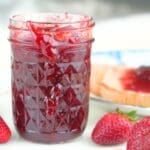
Canned Strawberry Jam Recipe
This canned strawberry jam recipe captures spring flavors with three simple ingredients. Made with whole berries, it delivers sweet, strawberry-filled bites in every spoonful. Beginner-friendly and great for small pantries!
Servings: 6 half pint jars
Calories: 831kcal
Equipment
- Mason jars (pints)
- Lids and rings
Ingredients
- 8 cups strawberries hulled and crushed
- 4 tablespoons bottled lemon juice
- 6 cups granulated sugar
Instructions
- Following the manufacturer's instructions, prepare your water bath canner, lids, and jars. I always put the jars in the canner so they stay hot.
- Attach a frying or candy thermometer to a large, heavy-bottomed stainless steel pot. Add the crushed strawberries, lemon juice, and sugar. Stir well to combine.8 cups strawberries, 4 tablespoons bottled lemon juice, 6 cups granulated sugar
- Bring the strawberry mixture to a boil over medium heat, stirring continuously to help the sugar dissolve and to prevent burning.
- Boil until it thickens and reaches 220° F (adjust the temperature for high altitudes as needed). Stir frequently to prevent scorching, especially as it thickens. Once it initially comes to a boil, it can take 40-60 minutes to reach 220° F.
- Use a jar lifter to remove the jars from the canner and fill the hot jars with hot strawberry jam, leaving 1/4" headspace. Use a clean debubbler to slide around the jar’s edges and release air bubbles. Re-check the headspace and add more jam if needed.
- Wipe the jar rim with a clean, damp paper towel. Place a lid on each jar, making sure it is centered. Add a band to each jar and twist it until fingertip tight.
- Place the jars in the canner, covering them with at least 2" of water. Cover and return to a boil. Process them in the boiling water for 10 minutes, adjusting for altitude if necessary. Before starting the timer, the water must be at a rolling boil. If it at any time during processing it drops below a boil, you will need to restart the processing time.
- After processing, turn off the heat, remove the lid, and allow the jars to sit in the water bath for 5 minutes. This will help them acclimate to the temperature change and prevent siphoning.Remove the jars from the canner and let them sit undisturbed for 12-24 hours. Check the lids for a proper seal before removing the rings and storing.
Notes
- Before starting, sterilize the jars by running them through the dishwasher, and wash the lids and rings in warm, soapy water. Also, make sure your kitchen and work surfaces are thoroughly cleaned before canning.
- I've found the most accurate way to test if the jam will set is by taking the temperature. At sea level, it should reach 220° F. For every 1,000 feet above sea level, the set temperature drops 2° F. Adjust as needed.
- You can use a small amount of slightly underripe fruit (no more than 25% of the total amount) to boost the natural pectin and help the jam set.
- If possible, use a wide, heavy-bottomed pot to let the moisture evaporate quickly and promote even cooking.
Nutrition
Serving: 1jar | Calories: 831kcal | Carbohydrates: 214g | Protein: 1g | Fat: 1g | Saturated Fat: 0.03g | Polyunsaturated Fat: 0.3g | Monounsaturated Fat: 0.1g | Sodium: 4mg | Potassium: 298mg | Fiber: 4g | Sugar: 209g | Vitamin A: 23IU | Vitamin C: 113mg | Calcium: 33mg | Iron: 1mg
