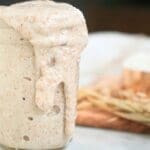
Beginner Sourdough Starter Recipe
Learn how to make sourdough starter from scratch. All you need is flour, water, and a little patience. With this easy-to-follow routine, you'll soon be on your way to enjoying the simple pleasures of baking sourdough bread.
Servings: 1 jar of starter
Calories: 782kcal
Ingredients
To Begin Your Starter (Day 1 & 2)
- 113 g whole wheat flour
- 113 g water, room temperature
To Feed Your Starter (Days 3-end)
- 57 g whole wheat flour
- 56 g all-purpose flour, unbleached
- 113 g water, room temperature
Instructions
Day 1
- In a clean jar, combine 113 g whole wheat flour and 113 g water (1 cup flour, ½ cup water). Stir until smooth and thick, like pancake batter.Cover loosely with a cloth or lid and let sit at room temperature for 24 hours.113 g whole wheat flour, 113 g water, room temperature
Day 2
- By Day 2, you may or may not see bubbles. Measure 113 g of starter into a clean jar and discard the rest.Add 113 g flour and 113 g water, then mix well. Cover and rest at room temperature for 24 hours.It’s normal for a new starter to rise quickly at first and then slow down. This early doubling is just the yeast and bacteria stabilizing. Continue feeding as directed, even if it doubles now.
Day 3-End
- Measure 113 g of starter into a clean jar and discard the rest. Add 57 g whole wheat flour, 56 g all-purpose flour (113 g total), and 113 g water.Mix thoroughly, cover, and let sit for 12 hours.After 12 hours, repeat the same process using half whole wheat and half all-purpose flour.Continue feeding every 12 hours until the starter consistently bubbles, doubles in size, and smells like sourdough. This process usually takes 5–10 days or longer, depending on conditions.57 g whole wheat flour, 56 g all-purpose flour, unbleached, 113 g water, room temperature
What To Do with Your Established Starter
- Once your starter is regularly doubling, it's time to start baking! When you are ready to bake, use the amount of starter called for in the recipe. Don't forget to leave some in the jar to save as your "master starter." What's left in the jar is what you will feed and maintain for future baking.
How To Store & Maintain Your Starter
- For weekly/occasional baking, store your starter in the fridge and feed it weekly. For daily baking, keep your starter on the counter and feed it every 24 hours.
Video
Notes
- Need more help with your starter? My Sourdough Starter for Beginners course walks you through making a healthy starter and baking your first loaf with confidence!
- After each feeding, you can mark where your starter began by placing a rubber band on the jar at the same height as your starter. That way, you’ll be able to tell if it is doubling.
- The lid should not be tight. The bacteria and yeast's off-gassing creates pressure that can shatter the glass if there isn’t breathing room. Use 100% cotton secured with a rubber band or a loose-fitting lid.
- Mold is always a no-go. Unfortunately, if you see mold, you will have to throw away your starter and go back to the drawing board.
- Once your starter is established, you can cook and bake with the discard. Until then, while the bacteria and yeast work themselves out, throw the discard in the trash (not down the sink).
- Sourdough starter is surprisingly resilient. If you forget to feed it, discard it and resume your regular feeding schedule.
Nutrition
Calories: 782kcal | Carbohydrates: 165g | Protein: 28g | Fat: 5g | Saturated Fat: 1g | Polyunsaturated Fat: 2g | Monounsaturated Fat: 1g | Sodium: 16mg | Potassium: 677mg | Fiber: 20g | Sugar: 1g | Vitamin A: 15IU | Calcium: 73mg | Iron: 9mg
