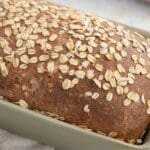
Sourdough Maple Oatmeal Sandwich Bread
This sourdough maple oatmeal sandwich bread is the perfect whole-grain bread for fall. Made with whole wheat flour, rolled oats, and a touch of maple syrup, it's versatile and nutritious. Perfect for toasted sandwiches, a quick PB&J, or hearty French toast
Servings: 1 loaf
Calories: 231kcal
Ingredients
Soaker
- 85 g 1 cup rolled whole oats
- 118 g 1/2 cup water, room temperature
Dough
- 150 g 3/4 cup sourdough starter, (100% hydration, active and bubbly)
- 230 g 1 cup whole milk
- 90 g 1/4 cup + 1/2 tablespoon maple syrup
- 14 g 1 tablespoon olive oil
- 100 g 1/2 cup whole wheat flour (fresh milled or store-bought)
- 375 g 3 cups bread flour (plus more inclusions)
- 10 g 2 teaspoon kosher salt
Oatmeal Topping
- 20 g 2 tablespoon rolled whole oats
- A spritz of water
Instructions
Prep the Soaker
- In a small bowl, mix the oats and 1/2 cup water. Set aside.
Make the Dough
- In the bowl of a stand mixer, add the dough ingredients.
- Mix the ingredients on low speed using a dough hook attachment. If needed, scrape the sides of the bowl with a spatula.
- Once the ingredients are mixed and the dough is shaggy, bump up the speed to medium. Knead until the dough is elastic and smooth. You will know it is ready when it passes the windowpane test. For me, this takes about 10-15 minutes. (If your dough feels too sticky, add one tablespoon of flour at a time until you can handle it without it sticking to your hands).
Add the Soaker
- Add the oatmeal mixture on top of the dough. Use your hands to gently work the oatmeal into the dough. Don't worry if it doesn't mix in entirely at this point.
- Return the bowl to the stand mixer, and use a dough hook to knead the dough again for just a minute or two. If your dough is wet from the soaker, add 1-2 tablespoons of flour while mixing. Don't overmix at this point. The goal is to incorporate the oatmeal into the dough. Don't worry if the oats make the dough look a little lumpy. The texture will eventually soften during baking.
Bulk Ferment
- Drizzle a little bit of avocado or olive oil in a bowl. Use the oil in the bowl to lightly coat all sides of the dough. This will help prevent it from drying out during the first rise or bulk fermentation.
- Cover the dough with a loose lid or a damp towel. Let the dough bulk ferment at room temperature for 8-12 hours or until approximately doubled. If you need to speed up the process, put the dough in a warm spot or a proofing box.
Second Rise and Shaping
- Once doubled, lightly grease or butter a loaf pan. Set aside.
- Turn the dough out onto a clean counter or work surface.
- Use your fingers to shape the dough into a 6" x 10" rectangle.
- Fold the long edges toward each other, meeting in the center, and pinch the seams together.
- Then, fold the short edges 1" toward the center and pinch the seams together.
- Turn the bread over so it is seam-side down, and tuck the ends in to create a little tension on the dough's surface.
- FOR SAME-DAY BAKING: Place the dough in the prepared bread pan and cover it with plastic (I use a plastic shopping bag). Let the dough rest for a second rise until doubled in size and domed in the center, usually 2-3 hours. After it has doubled, skip to Step 2 below. FOR NEXT-DAY BAKING: Place the dough in the prepared pan, cover with plastic, and refrigerate overnight.
Add the Topping and Bake
- Preheat the oven to 450° F.
- When the dough is doubled and domed, spritz the top with a little water or use a wet hand to lightly moisten the top of the dough.
- Sprinkle 2 tablespoons of rolled oats on top. Try to arrange them in a single later. If they overlap, the oats on top won't stick.
- Drop the temp to 400° F and bake for 45-50 minutes. Around the halfway mark, I had to tent the dough with foil to prevent over-browning, so keep an eye on it and add foil if necessary.
- The bread is ready to come out of the oven when it reaches an internal temperature of 200° F.
- Allow it to cool in the pan for a few minutes. Then, remove it from the loaf pan and place it on a wire cooling rack. Cool to room temperature before slicing.
Notes
- I have made this with store-bought whole wheat and fresh-milled red hard winter wheat. Both turned out great.
- If you are using fresh-milled whole wheat, you may need to add a little extra liquid. Fresh-milled grains absorb more liquid, so check your dough while mixing. You can also let the dough rest for 30 minutes once it's shaggy (before the 10-15 kneading). That gives time for the liquid to absorb and will give you a better indication if you need to add more liquid.
Nutrition
Serving: 1 | Calories: 231kcal | Carbohydrates: 44g | Protein: 7g | Fat: 3g | Saturated Fat: 1g | Polyunsaturated Fat: 2g | Cholesterol: 2mg | Sodium: 335mg | Fiber: 3g | Sugar: 6g
