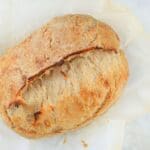
Sourdough Croissant Bread
Sourdough croissant bread is an artisan loaf with buttery layers and a flaky crust...all without the fuss of making traditional croissants. It's a simple no-knead sourdough boule filled with butter, creating a delicate and tender loaf that is beyond delicious.
Servings: 16 slices
Calories: 164kcal
Ingredients
- 475 g bread flour
- 355 g water
- 100 g sourdough starter active and bubbly
- 10 g salt
- 114 g butter frozen and shredded
Instructions
- Freeze and Shred the Butter. Freeze the butter for about 1 hour. Shred it, then return it to the freezer until needed.114 g butter
- Mix the Dough. In a large bowl, combine the bread flour, water, sourdough starter, and salt. Mix by hand for about 5 minutes, or until fully combined. Cover with a damp towel and rest for 30 minutes.475 g bread flour, 355 g water, 100 g sourdough starter, 10 g salt
- Stretch and Fold 1: Begin the stretch and fold process. Stretch and fold the dough until you begin to feel resistance from the dough (for me it's about 5-8 times). Cover with a damp towel and let the dough rest for 30 minutes.
- Stretch and Fold 2. Sprinkle half of the frozen shredded butter over the dough. Perform another set of stretch and folds. It's okay if the butter isn't fully incorporated. Cover and rest for 30 minutes.
- Stretch and Fold 3. Add the remaining butter and perform another set of stretch and folds. Cover and rest for 30 minutes.
- Stretch and Fold 4. Do one final set of stretch and folds.
- Bulk Ferment: After the final cycle of stretch and folds, cover the dough and bulk ferment until the dough has risen by about 70% or so and bubbles start to form around the edges of the dough (usually around 6-8 hours for me).The trick to flaky croissant bread is to ensure the butter doesn't melt. So for this recipe, try to keep the dough in a place no warmer than 72° F. Do not use a warm proofing box for this recipe.
- Turn Out the Dough. Turn the dough onto a clean work surface.
- Bench Rest. Shape the dough into a loose ball by turning and dragging it toward yourself to build surface tension. Rest for 15 to 20 minutes.
- Shape. Place the dough smooth side down in a floured banneton or towel lined bowl. Fold the long sides to the center and pinch to seal. Then fold the short sides about 1 inch toward the center and pinch to seal.Tip: The butter can make the seams difficult to seal. Pinch them as well as you can now, then reseal them after the cold proof if needed.
- Proof. Cover it with plastic wrap or a plastic bag (I like to use a plastic shopping bag), and stick it in the fridge for 12-15 hours.
- Preheat. Place a Dutch oven in the oven and preheat to 475°F. Heat for at least 20 minutes so the Dutch oven is piping hot.
- Reseal the Seams. Remove the dough from the fridge. If the dough’s seams opened during the cold proof, reseal them.
- Turn Out the Dough. Turn the dough out onto parchment paper, smooth side up.
- Score. Rub the top with flour, and score the dough with a lame or razor blade.
- Transfer to the Dutch Oven. Use the parchment as a sling to lower the dough into the hot Dutch oven. Leave the parchment underneath while baking.
- Bake. Reduce the oven to 450°F. Cover and bake for 25 minutes. Remove the lid and bake for another 12 to 15 minutes, or until the loaf is golden brown and reaches an internal temperature of 190°F to 200°F.
- Cool. Remove from the Dutch oven and let cool to room temp on a wire rack. Then, let the bread cool for an additional hour to allow the butter to firm up and prevent a gummy crumb.
Notes
- Keep the butter very cold so it doesn’t melt into the dough. This creates the flaky, croissant-like crust.
- Ferment the dough at a cooler temperature to prevent the butter from softening too much. This is different from my regular no-knead sourdough recipe, which can ferment at a warmer temperature.
- Sourdough fermentation times vary, so watch the dough rather than the clock. It should be jiggly with bubbles forming around the bowl's rim. Usually, I wait until it has risen about 70% or so.
- Some of the butter will melt out during baking. This is normal and creates that delicious crust!
- This recipe uses fewer stretch and folds than my other sourdough recipes to prevent the warmth of your hands from melting the butter.
- Let the bread cool an additional hour after it reaches room temp. I've learned from experience that the butter needs time to firm (especially the butter that melts to the bottom of the bread). If you cut it too soon, the crumb can be gummy.
Nutrition
Serving: 1slice | Calories: 164kcal | Carbohydrates: 23g | Protein: 4g | Fat: 6g | Saturated Fat: 4g | Polyunsaturated Fat: 0.4g | Monounsaturated Fat: 2g | Trans Fat: 0.2g | Cholesterol: 15mg | Sodium: 290mg | Potassium: 31mg | Fiber: 1g | Sugar: 0.1g | Vitamin A: 179IU | Calcium: 7mg | Iron: 0.3mg
