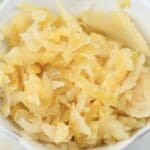
How To Make Homemade Sauerkraut
Learn how to make sauerkraut at home with just cabbage and salt. It’s simple, full of probiotics, and way better than store-bought. Enjoy it as a side or pile it on your favorite foods.
Servings: 8 servings (1 quart jar)
Calories: 28kcal
Ingredients
- 2 pounds cabbage
- 1 tablespoon salt any non-iodized
Instructions
- Remove a few layers of the outer leaves. Save one outer leaf and set it aside (you will need it later).2 pounds cabbage
- Cut out and remove the core. Thinly shred the head of cabbage, either with a food processor or a knife. Then, transfer the shredded cabbage to a large bowl.
- Sprinkle the salt over the shredded cabbage. Toss it together with your hands or a wooden spoon. Allow it to rest for 15 minutes.1 tablespoon salt
- Use your hands to massage the cabbage for 5 minutes. As you work the cabbage, it will release a lot of liquid. This is the brine you will use in the next step.
- Pack the cabbage into a clean mason jar, pressing it down firmly so it is covered with its own brine, leaving about an inch of headspace.
- Pour the remaining brine in the bowl over the cabbage to ensure it is fully submerged. The cabbage must remain completely under the brine during the fermentation process. If not, it may be exposed to air, which can encourage mold growth.
- Cut and fold one of the reserved outer leaves so that it's the same diameter as the jar. Place it on top of the packed cabbage. This will ensure that all of the cabbage stays under the brine.
- Place a fermentation weight on top. Top off the jar with the remaining brine to cover the weight. I like to do this over a bowl to catch any overflow.
- Add a fermentation lid to the jar. Then, put the jar in a bowl. Sometimes, as the cabbage ferments, the liquid can leak from the top. So the bowl will catch any drips.
- Ferment at room temperature until it is as tangy as you like. This can take anywhere between 3 days to a few weeks. I usually find that one week is about right for my taste buds. Taste your sauerkraut every few days to see if it is to your liking.
- When ready, remove the fermentation lid and folded cabbage leaf. Put a regular lid on the jar and store it in the fridge.
Notes
- Iodized and table salt can negatively impact fermentation. Pickling, kosher, and sea salts are good choices.
- Once your sauerkraut has finished fermenting, you can store it in the fridge for up to 6 months.
- I usually slice the cabbage by hand. But if you are fermenting a large batch, a food processor can speed up the process.
- Too much salt will inhibit the fermentation process, while not enough can cause unwanted bacterial growth. Use a 2% salt-to-cabbage ratio: 2 grams of salt per 100 grams of cabbage.
- I like using a glass fermentation weight, but you can use a large folded cabbage leaf, a pie weight in a ziplock bag, or even a small plate to keep the cabbage submerged.
- I like a fermentation lid, so I don't have to worry about burping the jar. Without a fermentation lid, you’ll need to release pressure each day.
Nutrition
Serving: 1 | Calories: 28kcal | Carbohydrates: 7g | Protein: 1g | Fat: 0.1g | Saturated Fat: 0.04g | Polyunsaturated Fat: 0.02g | Monounsaturated Fat: 0.02g | Sodium: 892mg | Potassium: 193mg | Fiber: 3g | Sugar: 4g | Vitamin A: 111IU | Vitamin C: 42mg | Calcium: 46mg | Iron: 1mg
