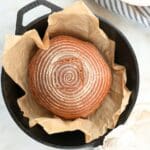
Fresh-Milled Einkorn Sourdough Bread Recipe
This fresh-milled einkorn sourdough bread recipe is 100% whole grain—and soft, chewy, and delicious. Made one day and baked the next, it develops a rich tang, crusty exterior, and beautiful oven spring.
Servings: 1 boule
Calories: 177kcal
Equipment
- Grain Mill
Ingredients
- 545 g fresh-milled einkorn flour plus more for dusting (4 1/2 cups)
- 290 g water 1 1/4 cups
- 150 g sourdough starter active and bubbly (3/4 cup)
- 10 g salt 1 1/2 tsp
Instructions
MAKE THE DOUGH
- Autolyze the Flour: In a large mixing bowl, combine the flour and water. Mix with a Danish dough whisk or wooden spoon until combined. Cover with a damp towel and let sit for 15 minutes.545 g fresh-milled einkorn flour, 290 g water
- Add Starter and Salt: Add the starter and salt to the flour-water mixture. Mix with your hands until thoroughly combined and no dry ingredients are in the bowl. The dough will seem stiff at this point, which is normal. Cover with a damp towel and set aside for 1 hour.150 g sourdough starter, 10 g salt
- Turn Out the Dough: Generously flour a clean counter with einkorn flour. Use a plastic bench scraper to loosen the dough from the edges of the bowl and turn out the dough onto the floured work surface. Flour the top of the dough.
- Fold the Dough: Start with one side of the dough, gently stretch it outward and fold over toward the center. I find it helpful to lightly press on the center of the dough with one hand and pull with the other. Repeat the folds on all four sides of the dough. Return the dough to the bowl and allow to rest for 30 minutes. Then, repeat the folds, return the dough to the bowl, and cover with a damp towel.
- Bulk Ferment: After the second round of folds, cover the dough with a damp towel and allow it to ferment in bulk until it has risen by 20%- 30% or until it is domed on top.
- Shape the Dough: Generously flour the countertop. Use a plastic bench scraper to help you turn out the dough onto the floured counter. Try not to deflate the dough. Use your hands to turn the dough so it forms a tight ball.
- Transfer to a Basket: Smooth a little flour on top of the dough. Then, transfer the dough ball FACE DOWN into a floured 7" banneton basket or towel-lined bowl. Gently pinch the left and right sides together. Then, pinch the top and bottom together. This creates tension and a nice seam.
- Cover and Cold Proof: Cover with plastic (I like to use a plastic shopping bag), and stick in the fridge for 12-15 hours.
THE NEXT DAY
- Prep the Oven: Preheat the oven to 500° F with a cast iron Dutch oven inside.
- Score the Dough: Once the oven is preheated and the Dutch oven is scorching hot, turn the dough out onto a piece of parchment paper. Using a bread lame, score the top of the dough, no deeper than 1/4".
- Bake: Drop the oven temp to 450° F and transfer the dough to the Dutch oven. Bake for 40 minutes covered. Then, take off the lid and bake for another 5 minutes. Bread is generally considered “done” at an internal temperature of 190-200° F.
- Cool: Remove from Dutch oven and let cool to room temp on a wire rack.
Video
Notes
- A 7" banneton basket has taller sides and supports the dough. This will give you a fuller, taller loaf.
- I always mill a little extra einkorn for sprinkling on the counter and on top of the dough so it's easier to handle.
- I prefer cold proofing einkorn sourdough because it develops more flavor. However, you can skip the cold proof. Just shape it and let it rise a second time for 30 minutes to 1 hour in the banneton before baking.
- Einkorn absorbs water more slowly than white flour, so don't skip letting the flour and water rest.
- Focus on the dough, not the clock. Fresh-milled flour ferments faster than store-bought, so bulk fermentation may finish sooner depending on your starter and temperature.
Nutrition
Serving: 1 | Calories: 177kcal | Carbohydrates: 37g | Protein: 7g | Fat: 1g | Polyunsaturated Fat: 1g | Sodium: 325mg | Fiber: 5g
