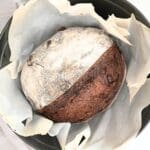
Chocolate Sourdough Bread
This artisan chocolate sourdough bread is crusty on the outside, warm and chewy on the inside, and filled with gooey chocolate. It's made with my beginner's no-knead sourdough recipe with added cocoa, brown sugar, and chocolate chips. It's hands-off and simple, and beyond delicious.
Servings: 12 slices
Calories: 194kcal
Ingredients
- 375 g all-purpose flour
- 100 g whole wheat flour
- 10 g salt
- 50 g brown sugar
- 50 g cocoa powder unsweetened
- 100 g sourdough starter active and bubbly
- 335 g water
- 1/4 cup chocolate chips
Instructions
- Mix Dry Ingredients. In a large bowl, whisk together all dry ingredients except the salt and chocolate chips.375 g all-purpose flour, 100 g whole wheat flour, 50 g brown sugar, 50 g cocoa powder
- Add Water and Starter. Pour water and starter over the combined dry ingredients, and mix well. I like to use a Danish dough whisk for this. But your hands will also work just fine. Cover and allow to rest for 30 minutes.335 g water, 100 g sourdough starter
- Add Salt and Mix. Add salt and mix by hand for about 5 minutes. The dough should come together and be fully combined. Cover with a damp towel or place in a proofing box with a water tray. Allow to rest, again, for 30 minutes.10 g salt
- Stretch and Folds. Begin the first round of stretch and folds. This will be a stiffer dough than a traditional sourdough. So don’t be alarmed. Do the best you can to stretch the dough without tearing it.For each “round,” complete four stretch and folds. Stretch and fold for a total of three rounds with 15 minutes between rounds.Cover the dough with a damp towel or keep it in a proofing box between rounds.
- Roll the Dough. After completing three stretch-and-fold rounds, remove the dough from the bowl. Gently roll it into a thick rectangle-ish shape.
- Add Chocolate Chips. Add the chocolate chips on top of the dough. Fold the left and right sides over the chocolate chips. Then, fold the top and bottom edges over. Pinch the dough together to prevent the chocolate chips from falling out. Place the dough back in the bowl.1/4 cup chocolate chips
- Continue Stretch and Folds. Resume the stretch and folds. This time, do three rounds again, but with 30 minutes between each round. Cover the dough with a damp towel or keep it in a proofing box between rounds.
- Bulk Ferment. After the stretch-and-fold process is complete, allow the dough to bulk ferment until doubled and domed on top (in my 70-degree kitchen, this takes about 6 hours).
- Shape the Dough. Once the dough has doubled, turn it out onto a clean, dry counter. Shape the dough by twisting it clockwise to create tension.
- Cold Proof. Place upside down into a floured banneton basket. Gently pinch the left and right sides together. Then, pinch the top and bottom together. This creates tension and a nice seam.Cover with plastic (I usually use a plastic shopping bag). Place in fridge for 12-15 hours.
- Preheat the Oven. The next day, preheat a Dutch oven with a lid to 425°F for 20 minutes.
- Flour and Score. Once preheated, turn out the cold dough onto a piece of parchment paper. Flour the top of the dough and score.
- Bake. Keep the dough on the parchment paper, and place it inside the hot Dutch oven. Bake at 425°F for 20 minutes with the lid on. Remove the lid and bake at 425°F for 30 minutes. The bread is done when it reaches an internal temperature of 200-205°F.
- Cool and Enjoy! Transfer to a wire rack and allow to cool to room temperature before slicing.
Notes
- For the most accurate and repeatable results, I recommend using a kitchen scale and weighing in grams.
- Watch the dough, not the clock. How long it takes for your dough to ferment depends on the ingredients, the strength of your starter, and the temperature.
- Use an active, bubbly starter since the cocoa and sugar can slightly slow fermentation.
- The dough will be stiffer than regular no-knead dough, so don’t worry if the stretch and folds aren’t as stretchy.
- If you do not have a Dutch oven, place a skillet filled with water on the bottom rack and preheat it with the oven. Keep the skillet in the oven and bake the dough on the rack above to create steam for a better rise and crust.
Nutrition
Serving: 1slice | Calories: 194kcal | Carbohydrates: 40g | Protein: 5g | Fat: 2g | Saturated Fat: 1g | Polyunsaturated Fat: 0.2g | Monounsaturated Fat: 0.2g | Sodium: 327mg | Potassium: 143mg | Fiber: 3g | Sugar: 6g | Vitamin A: 1IU | Calcium: 20mg | Iron: 2mg
